Last Updated on September 23, 2024 by Chris and Lindsay
(September 10, 2024)
Hello again friend,
Living in the Black Hills of South Dakota is truly special. When we first passed through the area in the fall of 2018, we marveled at its hyper-scenic beauty. In the six months prior, we had traveled some 20,000 miles, meandering through two dozen US states and exploring the best each had to offer on our way toward the Alaskan Arctic Ocean.
We had seen mountains before – spectacular mountains like the Colorado Rockies, the Grand Tetons and even the elusive Mt. Denali, which towers above all others in Alaska.
We had seen wildlife before – black and brown bears, eagles and the famous leaping salmon in Alaska, moose, elk and bison in Wyoming, roadrunners in Texas and New Mexico and all sorts of wildlife in between.
We had driven twisty-turny roads in Colorado, Utah, and Idaho, and we gasped many times at every view beyond the next bend on some of the most beautiful roads in America.
But somehow, in this small part of an oft-forgotten state, incredible landscapes can be explored by driving the narrow, twisty roads where wildlife is abundant. It is truly a special place.
Despite our doubts about returning so late this season, this third season has taught us something we already knew, but for which we appreciate a gentle reminder.
Most mornings, I walk the dogs down a stretch of dirt road called Lame Johnny. It begins behind the horse barn and carries on several miles through a horse camp and then into the hills and prairies, where most of the area’s wildlife can be found.
We discovered this road on the second day of our first season, having trudged the day before through horse trails offering more challenges than enjoyment, such as dodging piles of horse poop and returning home with ticks crawling around our skin.
Lame Johnny leads away from our camp and through an area with a few historic cabins before it peaks at the top of a hill overlooking a valley—my valley, as I have claimed it. From there, the road drops quickly over a quarter mile before crossing French Creek along an old wooden bridge and turning sharply back into the valley.
The next mile or so is my favorite of any stretch along the many miles of dirt roads that crisscross the Black Hills.
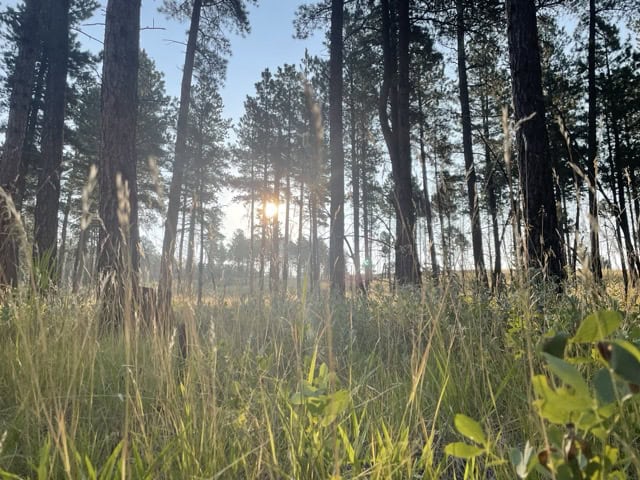
Far enough away from any signs of civilization, it is here where my mind releases my thoughts, prayers and praise and some of the freshest air in America fills my brain with the oxygen it needs to function more clearly. Typically, Huckleberry, our youngest Blue Heeler, has already run several miles back and forth through the forest, blanketed in fallen ponderosa pine trees and patches of tall grass that attract an occasional bison or deer.
When he runs, some wildlife typically stirs up as well. During my morning walks in this stretch of the forest, I’ve seen bighorn sheep, deer, coyotes, bison, and even elk among the field mice, chipmunks and squirrels.
When I tell Lindsay about what I’ve seen on any particular day, she usually gets excited and wants to grab her camera gear to take photos. She loves taking photos of the wildlife out here – it is easily her favorite thing about living in the Black Hills.
But in the few times she has retraced my steps, the wildlife has long since moved on, and all that is left is the tall grass and gentle roar of the wind through the ponderosa pines.
I’ve learned through the years that this place is special to me, and perhaps me alone. It’s not that Lindsay can’t share in this experience. Nor does it exclude others who pass through and take photos of the valley from the wooden bridge over French Creek.
But this valley is mine because I’ve earned my claim to it by spending the better part of three years getting to know it, one step at a time, one day after another.
It is tempting to think that one might become bored with walking the same 4 or 5 miles every day. And there are certainly days when I consider lying in bed just long enough that I excuse myself from my morning walk.
But I am excited more than not by the idea that something special is going to take place each morning that I find myself strolling through the woods on that stretch of dirt road. I may have incredible breakthroughs in my spiritual walk with God. Or I’ll have a breakthrough about our business or some task on which I’ve been hung up.
Maybe I’ll see a bison mosey past in front of me, turning its head to nod in approval of our shared respect for these woods. Or perhaps an elk will stand tall on the crest of a ridge, looking down on me with the same approval before walking over the top and bugling toward its partner.
Whatever the day holds, it begins to reveal itself during these walks, typically in this stretch of road where, incidentally, the endorphins kick in and lock in the euphoria of the morning. No two mornings are ever the same. But every one is special in its own way.
After graduating from college (Go Gators!), I embarked on a solo backpacking trip through South America. What started as an eager attempt to learn Spanish while immersed in the culture of Quito, Ecuador, turned into a four-month wander from the top to the very bottom of the continent and then back up again.
Although I experienced some incredibly profound and beautiful moments, one that I remember most took place on a freight ship with some converted space for budget-minded backpackers like myself who didn’t mind sleeping on a triple bunk and eating sailor’s meals in exchange for the beauty of the fjords of Chilean Patagonia.
We were sailing for three days from a port midway down the Chilean coast through the Patagonian fjords to the small town of Punta Arenas. Although the amenities onboard the ship were minimal, the views were incredible and well worth the gruel I ate thrice daily and the sleep I lost each night on a most uncomfortable mattress.
Other passengers, primarily backpackers like myself, wanting to skip some of the boring parts of the region by land, experienced some of the lesser-visited landscapes by sea. However, one such man I met was a photographer for a little publication called National Geographic.
Tomas did not wear his credentials on his chest like many might imagine. You never would have known what profound experiences he could relate from behind the lens of a camera if you had not shared a coffee with him—which is exactly what I did on our third day at sea.
Like so many, at 22 years of age and with a college diploma hot off the press, I had grand aspirations for life. One of these aspirations was to travel, write, and take photographs.
Writing has always been my first passion, a profound gift I discovered when I was seventeen years old. But all things creative inspire me, and I have dabbled in the creative arts of photography and videography, as well as taking up guitar and writing poetry from time to time.
I told Tomas I was on my way south to reach the southern end of the world and to spend a few days hiking the world-famous Torres del Paine, the most well-known Chilean National Park. Before we left, I had made a few friends in port who invited me into this adventure, and at this point in life, I was eager to absorb every experience I could have.
Tomas nodded in approval of my plans and then shared his love of Torres del Paine. Like Mt. Denali in Alaska, the mountain “towers” for which the park is named are rarely visible due to the wild weather that occurs the closer you are to the poles. While many photographers will spend days or perhaps weeks waiting for the cloud cover to release for the iconic photo of the towering rock faces, Tomas was there for a different reason and for a much longer time.
He was on assignment to photograph a rare puma in the rugged Patagonian mountains. Finding where the elusive puma called home was just the beginning of the process, which also included hiking multiple days, often through the snow, to spend another few days waiting for just one glimpse of the creature.
Tomas spent months of his life, year after year, waiting for the puma and her cubs to be at the exact same place and time as him. Finally, in his third year, he captured the photos that made the magazine cover that so many people have probably seen and since filed away in a cardboard box stashed away somewhere in their garage or attic.
We consume so much content daily that it overwhelms our senses. When you see one of Tomas’ photos, you appreciate its beauty for a moment and then quickly turn a page and look for the next sensational photo that attracts your eye.
For us, the moment passes in the turning of a page.
But for Tomas, it took years of his life, and the moment he snapped his first photo of the puma, it became something that defined him, a moment that he would never forget.
Yet, as profound as his lesson was to find that thing worth the waiting day after day, year after year, it was not the photo of the puma that so captivated Tomas and gave him the authority of ancient sages. Rather, it is the lesson of what is found in the present moment while waiting.
As Tomas related to me that first photo and all of the subsequent ones that filled the pages of that particular magazine, he was most passionate about helping me understand that something magical happens in the waiting.
If you live in expectation of that next thing, it is tempting to overlook the beauty of the present. Although Tomas trudged through the snow week after week for three years, he recalled little moments he had along the way to his lookout that are similar to that mile stretch of dirt road through the Black Hills of South Dakota.
There were other animals he saw that he befriended while he was waiting. Animals not worth the cover of National Geographic. But worthy of his attention in the moment. And the silence he described is only imaginable to someone who has spent days sitting on a rock outcrop as the wind blew through the snow-filled trees or small avalanches slid down nearby mountainsides.
“There is beauty in every moment,” Tomas related to me almost twenty years ago to the day. “Live for that, and you will find the thing you seek.”
Although it has been decades since I sat with Tomas and chatted over coffee, many years of which I have not lived well in the beauty of each moment, it is mornings like this as I wander through the woods into my stretch of solitude where I realize how incredible life is.
With all of the things I do on any given day, thousands of thoughts and micro-thoughts about dozens of tasks and interactions with people, it is easy to forget to breathe. Fortunately, God automated that process for us.
But what if we realized how precious the act of breathing was? We only have so many breaths before we return to dust. Yet so many pass by without notice, tiny miracles in and of themselves that we should strive not to take for granted.
Lindsay and I have only so many more days here this season before we begin our quick journey back toward Florida and then head west toward an exciting season of travel and business in Baja. And for as much as I have to do in the meantime, both professionally at my management job and with the two companies we run, it is easy to look toward Baja as my puma, a reward for a season of work and waiting.
It is easy to be distracted by the routine—trudging through the snow, so to speak—in the expectation that one day the trudging will end because the reward for the waiting will be achieved.
But I refuse to let go of the beauty of each moment here. This place is sacred. But so is your back yard, the trail behind your neighborhood or the daily drive to work. It’s a moment on the couch after the kids go to bed or in the early morning while the coffee is brewing.
There is beauty in the waiting. But it only matters that we see it and live in it as much and as often as we can.
Life is designed such that most of us do not have the luxury of avoiding the daily grind. And for many, the daily grind has gone on for twenty, thirty, forty years or more where we’ve made the reward for such labor a few short years of “retirement” before we kick off onto the next life.
I’m not trying to flip the world upside down. I’m not saying anything new or profound. I am now old enough to know that no rebel worth his cause has ever truly succeeded. The way of the world is so overwhelming that the idea of “counter-culture” has become associated with anarchy and unrest.
However, I am committed to living what Jesus called the Abundant Life, and it is my hope that as Lindsay and I continue on our journey, we can encourage and inspire you to live with just a little more purpose and intentionality in moments like this.
Put your phone down now. Close your computer. Take a deep breath. Feel it in your lungs. Breathe out.
That’s one of some twenty-thousand or so breaths you’ll have today, most of which will happen without notice.
Breathe again. Think about the miracle of life and how the oxygen in that breath is being transferred inside your lungs, where it will ride tiny little blood cells to every part of your body, particularly your brain, where you will make the next decision in your life, however large or small.
The photo of the puma is the cherry on top of the many journeys out and back. Life is found in the trudging toward whatever your puma may be. Whether you find yourself sharing my one-mile stretch of Lame Johnny road in the Black Hills of South Dakota or you have your own sacred stretch somewhere else, I encourage you today to focus on the process of living and not on life itself.
In a few weeks, we’ll be gone again. We’ll likely backtrack on much of the journey home as we have driven on our way out (except for Nebraska, of course… we’re avoiding ALL of Nebraska!). We know the roads and the stops along the way. We have our routines for long travel days and all they entail.
But just as that breath is unique because of my focus on it, every day between now and then and, God-willing, the many days that follow will remain precious and beautiful – if only for the miracle of twenty thousand or so breaths of each day.
I pray you take the time to find a place where you can be overwhelmed with the beauty and simplicity of life. Take a breath amid routine and realize what that moment means right then and there.
We can’t all live in such moments. At times, we will be overtaken by the many distractions that often necessitate a break from the profound.
But I hope that in the next season of life when I leave my sacred stretch of dirt road behind, I will be more aware that this dirt road is simply a way to engage and reset myself, the same as embracing one of twenty thousand or so breaths each day.
May you find your peace today, and the clarity of purpose that will follow.
Much love,
Chris & Lindsay + Everest + Huckleberry!
About Author
